For twenty years, enterprise sales has run on the same rails: discovery call, demo, implementation, negotiation, renewal. The demo was the hinge — everything before it built toward it, everything after it depended on how well it landed.
That cycle is breaking for AI products, for a specific reason.
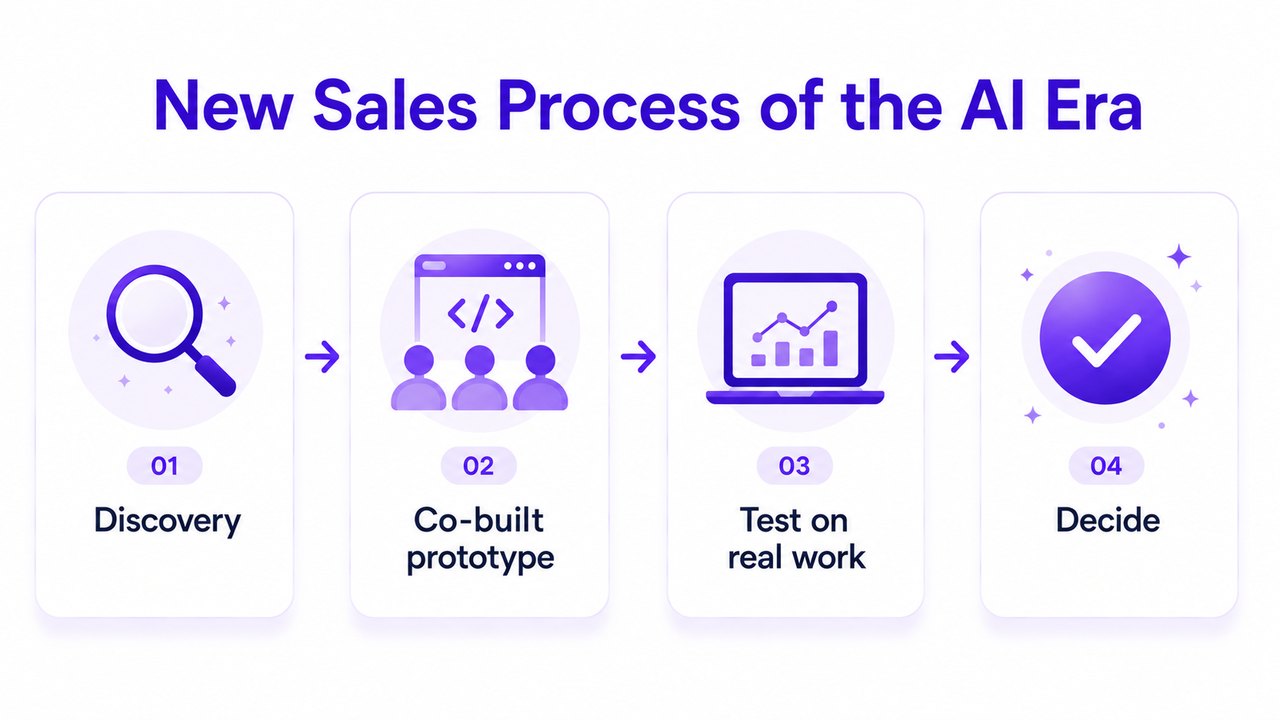
A demo can’t answer the only question that matters
A demo shows the happy path — a curated dataset, a scripted flow, someone else’s use case dressed up to look like yours. That’s fine for deterministic software: if it works in the demo, it works the same way in your environment. But the whole question with an AI product is whether it works on your messy data, on the problem you actually have. A demo can’t answer that. Only your own data can.
So the cycle is shifting from discovery → demo → implement to discovery → build a working prototype together → test it on real work → decide. The vendor and buyer build something small and real, the buyer’s team uses it, and the results — not a slide deck — make the case.
We do this ourselves. We roll the product out to a handful of real users first; if they get value, more people try it, and it expands from there. To be clear, we still do demos, for good reason — this isn’t an argument that demos are dead, just that the center of gravity has moved.
What changes for the solutions engineer
That shift changes what a solutions engineer does. The job stops being “prepare and deliver a strong performance” and becomes “co-build something real with the customer, fast.” Different skills: less polish and pacing, more technical range and comfort building under pressure on the customer’s own inputs.
“Let’s stop” is a legitimate outcome
It also changes what a good outcome looks like. In the old cycle, a stalled deal meant a long, quiet fade. In the new one, “you’re not getting value here, let’s stop” is a legitimate outcome, not a failure — better for the buyer, who doesn’t sink months into something that isn’t working, and better for the vendor’s pipeline. Most vendors won’t say this part out loud. It’s probably the most useful part of the argument.
None of this is free
Prototypes cost more upfront than a demo — someone has to build the thing. Real data access often means clearing security review before you’ve proven anything. Procurement was built to evaluate finished software, not co-built pilots. And not every product can show value in a short window.
Those obstacles are why this shift is uneven rather than instant. But the direction is clear: buyers aren’t asking “can you show me this works?” anymore. They’re asking “can you show me this works for me?” Only a prototype on real data answers that — and the vendors who can build one fast, and who are honest when it doesn’t work, will have an easier time than the ones still polishing the demo.