Sales teams don’t fail because they lack tools or talent. They struggle because most reps are forced to learn in the worst possible environment—live customer conversations.
Think about it: the first time a rep handles a tough objection, navigates a competitive situation, or tries to uncover real buyer intent… it’s happening in front of an actual prospect.
There’s no room to experiment. No space to get it wrong. And very little opportunity to improve before it impacts revenue.
The highest-performing teams are changing that dynamic entirely. Instead of treating real calls as practice, they’re building systems that allow reps to refine how they sell before it counts.
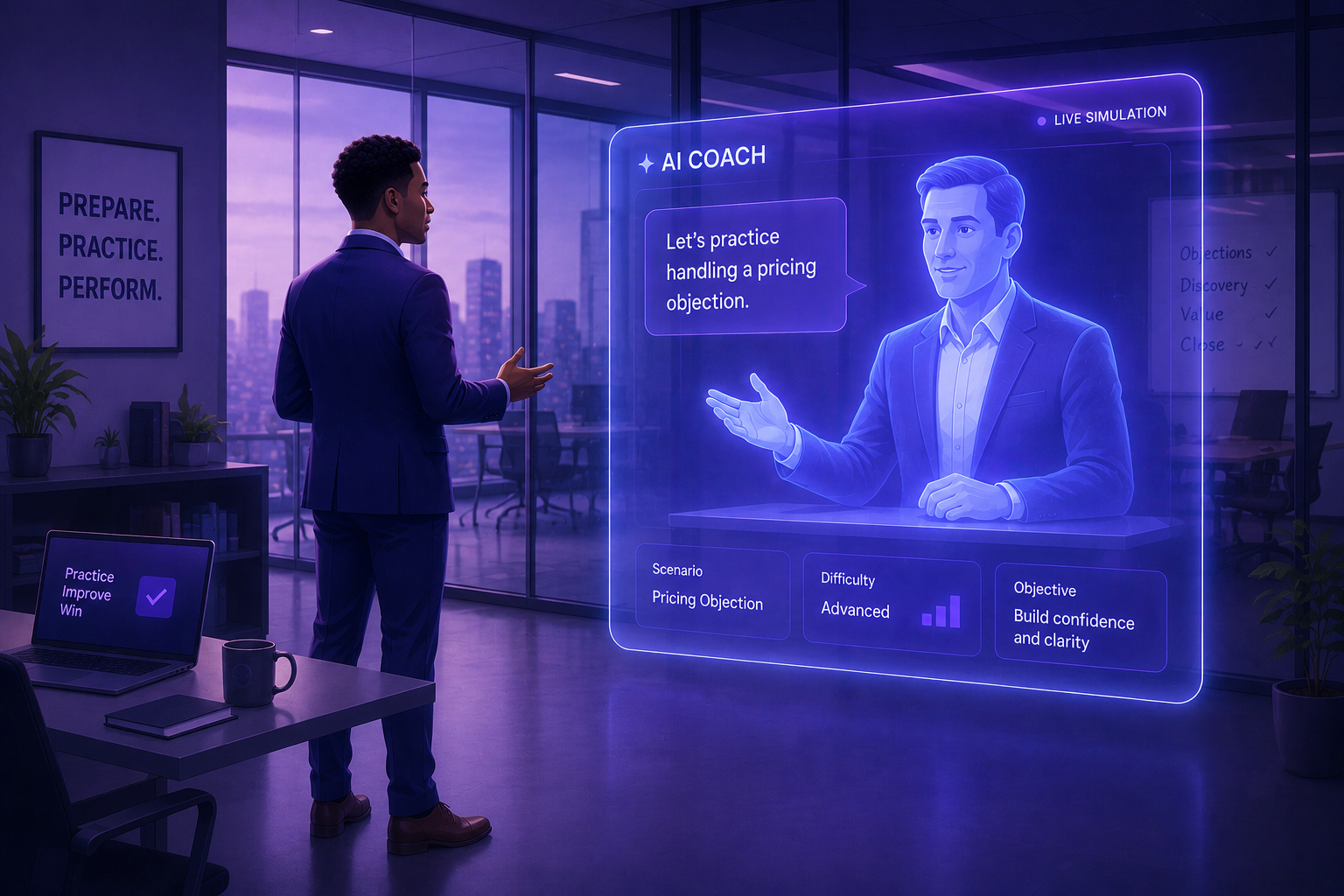
AI Coach and AI Roleplay for Sales Onboarding
Onboarding has traditionally been a one-way transfer of information—product knowledge, messaging, positioning.
But knowing what to say isn’t the same as being able to say it well.
This is where AI-driven coaching and simulated roleplay environments are making a real impact. They create a space where reps can actively practice conversations, not just memorize them. Instead of passively consuming information, reps engage in realistic scenarios that mirror actual sales calls.
The key difference is repetition. Reps can run through the same type of conversation multiple times, improving each iteration. They can test different approaches, refine their delivery, and build confidence without the pressure of a live deal.
That kind of repetition is almost impossible to achieve with traditional onboarding alone.
Objection Handling and Battlecards in Sales Training
Every sales team has battlecards. Every team trains reps on objection handling.
And yet, this is still where most deals fall apart.
The issue isn’t access to information—it’s the ability to use that information in real time. In a live conversation, there’s no pause button. Reps need to recall the right message, adapt it to the situation, and deliver it naturally.
Practice environments change how this works. Instead of reviewing battlecards in isolation, reps learn how to apply them under pressure. They experience common objections as they would happen in a real call and develop the instinct to respond effectively.
Over time, this builds fluency. Messaging becomes second nature instead of something reps have to consciously think through mid-conversation.
Competitor Intelligence and Buyer Need and Intent in Sales Calls
Understanding the competitive landscape and identifying buyer intent are two of the most critical skills in sales—and two of the hardest to execute consistently.
It’s one thing to know how your product compares to others. It’s another to respond confidently when a prospect brings up a competitor on the spot.
Similarly, recognizing buyer signals in theory is very different from doing it in a live conversation, where context, tone, and timing all matter.
When reps practice these scenarios ahead of time, they become far more adaptable. They learn how to reposition against competitors naturally and how to steer conversations based on what the buyer actually cares about—not just what’s in the pitch deck.
That’s where real differentiation happens.